A Program Structured Like An Academic Department
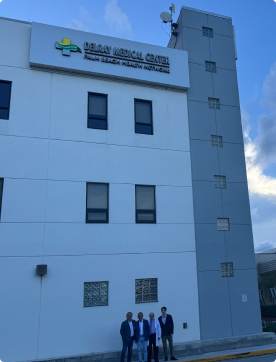
This reconstructive program operates within a Level I trauma center and is structured according to principles commonly associated with major academic departments.
Its framework is defined by:
- Technique development driven by clinical necessity
- Peer-reviewed publication and national presentation
- Multidisciplinary operative planning
- Defined doctrine across subspecialty domains
- Structured escalation pathways for complex failure
Although regionally based, the intellectual organization, operative infrastructure, and case complexity mirror larger academic institutions.
Innovation, education, and trauma reconstruction function within a unified system of care.
ACGME-Accredited Training Environment
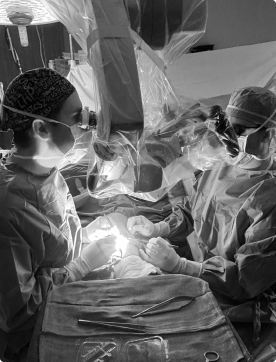
The program functions within an ACGME-accredited training environment and participates in the education of future surgeons and plastic surgeons.
Complex trauma reconstruction is integrated into resident training through structured operative exposure, multidisciplinary case planning, and supervised high-acuity management.
Education, quality oversight, and innovation operate within the same framework.
Participation in an ACGME training environment reinforces adherence to evidence-based standards, peer review, and continuous quality evaluation consistent with major academic centers.
Innovation Developed In The Operative Environment
Innovation in reconstructive surgery is often associated with major academic institutions.
High-acuity trauma creates a different laboratory.
Within the operative environment of a Level I trauma center, clinical necessity frequently precedes publication.
Techniques developed within this program arise from managing limb-threatening injuries, spinal wound failure, geriatric avulsion trauma, and complex reconstruction demands that exceed conventional algorithms.
Innovation here is trauma-driven.
Structural Muscle Reconstruction (SMART)
Segmental muscle transection and loss following high-energy trauma presents a distinct reconstructive challenge.
Traditional flap coverage restores soft tissue bulk but does not reestablish structural muscle continuity across full-thickness defects.
Within this program, a structured acellular matrix–assisted muscle reconstruction technique (SMART) was developed to restore continuity across segmental muscle transections.
The technique incorporates biologic scaffold reinforcement to bridge structural muscle deficits, allowing controlled cellular integration and restoration of mechanical continuity prior to definitive soft tissue coverage.
This approach emphasizes:
- Scaffold-guided biologic integration
- Preservation of native muscle architecture
- Structural reinforcement across full-thickness defects
- Integration with staged or definitive flap reconstruction
SMART was developed within the Level I trauma environment and has been presented at national and international surgical meetings.
The technique is currently the subject of peer-reviewed clinical investigation.
In limb salvage, restoration of structural muscle continuity influences long-term functional durability and limb viability.
Perfusion-Guided Tissue Salvage
Using intraoperative fluorescence (SPY) angiography, this program has demonstrated that most geriatric skin tears are functionally avascular at presentation.
This challenges traditional classification as random-pattern flaps.
Reconceptualization of these injuries as graft-equivalent constructs has informed a structured stabilization model associated with markedly reduced failure rates.
Perfusion imaging also informs decision-making in extremity salvage and complex wound reconstruction.
Operative sequencing is guided by physiology rather than assumption.
Negative Pressure Therapy In Trauma Reconstruction
Negative pressure wound therapy is frequently used in staged reconstruction.
Within this program, structured application of instillation-based systems and controlled negative pressure sequencing has been refined for:
- Infected spinal instrumentation
- Exposed orthopedic hardware
- Traumatic soft tissue loss
- Complex abdominal wounds
Application is physiology-driven, with defined goals of bioburden reduction, perfusion preservation, and preparation for definitive closure.
Optimization of negative pressure strategy remains an active component of reconstructive refinement within trauma-scale care.
Spinoplastics: Soft Tissue At The Spine Interface
Spinoplastics: Soft Tissue At The Spine Interface
Within this program, structured muscle flap strategies were developed for both prophylactic closure and postoperative salvage following spine surgery.
Spinoplastics represents the intersection of spinal surgery and plastic reconstruction.
Operative planning, vascularized coverage, infection control sequencing, and structured postoperative surveillance are integrated within the trauma center framework.
This model has been presented nationally and is undergoing peer-reviewed dissemination.
Geriatric Trauma Reclassification
Geriatric soft tissue trauma behaves differently from younger injury patterns.
Through clinical observation and perfusion validation, this program has contributed to reconceptualization of geriatric skin tears as structural avulsion injuries characterized by compromised microvascular integrity.
Operative stabilization techniques developed under this framework have reduced progression to necrosis and prolonged wound morbidity.
Ongoing peer-reviewed publication continues to define and refine this doctrine.
Abdominal Wall Reconstruction In Trauma & Complex Failure
Complex abdominal wall defects arise from:
- Trauma
- Emergent laparotomy
- Open abdomen management
- Infection
- Prior failed reconstruction
Reconstruction requires restoration of structural integrity, not simply fascial approximation.
Within this program, abdominal wall reconstruction incorporates:
- Component separation strategies
- Biologic scaffold reinforcement when indicated
- Infection control sequencing
- Durable fascial closure principles
Abdominal wall reconstruction in the trauma population requires coordination between acute care surgery and reconstructive planning.
Durability and recurrence prevention are prioritized.
National & International Presentation
Techniques Developed Within This Program Have Been Presented At National And International Surgical Meetings.
These presentations reflect dissemination of trauma-driven reconstructive strategies to broader surgical audiences.
Innovation is shared, scrutinized, and refined within the academic community.
From Trauma To Publication
Complex trauma frequently demands solutions not yet described in literature.
Within this program, innovation follows a structured pathway:
- Clinical necessity
- Technique development
- Outcome refinement
- Peer presentation
- Manuscript submission
- 6Broader adoption
Research is iterative and grounded in operative reality.
Collaborative Trauma Environment
Innovation occurs within a multidisciplinary Level I trauma ecosystem including orthopedic surgery, vascular surgery, neurosurgery, anesthesia, and critical care.
Techniques are refined within coordinated operative planning rather than in isolation.
Direct Collaboration & Referral
High-acuity cases requiring advanced reconstructive strategy, perfusion-guided planning, structural muscle reconstruction, complex wound salvage, abdominal wall reconstruction, or tertiary-level escalation may be referred for coordinated evaluation within the Level I trauma center at Delray Medical Center.